Why does interior paint peel and how can it be prevented? If you’ve spotted bubbling, lifting edges, or flakes coming off your walls, you’re not alone. At McGeachy & Goodyear Decorating, this is one of the most common issues we get asked to diagnose across Barking and East London.
The good news is simple: peeling paint is nearly always fixable. The even better news: if you understand why does interior paint peel and how can it be prevented, you can avoid paying to redo the same room again in six months.
The quick answer (what we see most often)
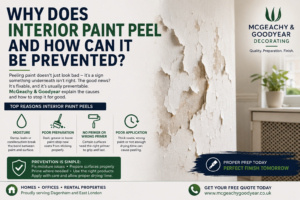
When customers ask why does interior paint peel and how can it be prevented, it usually comes down to one of these root causes:
- Moisture (condensation, leaks, damp, or painting before plaster is dry)
- Poor preparation (dust, grease, polish, unstable old paint underneath)
- Wrong primer or no primer (especially over shiny, chalky, or stained surfaces)
- Rushed application (thick coats, wrong paint for the room, not enough drying time)
At McGeachy & Goodyear Decorating, we treat peeling paint as a symptom, not the problem itself. If you want to solve why does interior paint peel and how can it be prevented, you fix the cause first.
1) Moisture: the number one cause of peeling paint
If you’re wondering why does interior paint peel and how can it be prevented, start with moisture. Moisture breaks the bond between paint and the surface. Over time, that creates bubbling, lifting edges, and eventually peeling.
Typical moisture culprits we see at McGeachy & Goodyear Decorating include:
- Bathrooms and kitchens with poor ventilation
- Condensation on colder external walls (common in older homes and flats)
- Small leaks (pipes, window seals, roofs) that quietly feed damp patches
- Fresh plaster that hasn’t properly dried before painting
How it’s prevented: Improve ventilation, fix leaks, let surfaces dry fully, and use the correct paint system for the room. Painting over damp is like putting a plaster on a wet sponge, it won’t stick for long.
2) Poor preparation: paint can’t stick to dirt (or to loose paint)
Another big answer to why does interior paint peel and how can it be prevented is prep. If the surface is greasy, dusty, polished, or covered in old wallpaper paste, paint can’t grip properly.
We often find peeling paint has been applied over one of these:
- Kitchen grease or cleaning residue
- Dust from sanding that wasn’t wiped down
- Old flaky paint that wasn’t removed back to a stable edge
- Glossy paint that wasn’t keyed (lightly sanded) first
- Wallpaper paste residue left behind
How McGeachy & Goodyear Decorating prevents it: We remove loose paint, feather edges, clean surfaces properly, and key shiny areas so the new coating has something to bite into. That’s the difference between “looks alright today” and “still looks great next year”.
3) No primer (or the wrong primer) on tricky surfaces
If you’re researching why does interior paint peel and how can it be prevented, priming is one of the most overlooked parts of the answer. Some surfaces need a primer or sealer, otherwise paint sits on top rather than bonding.
Common examples where primer matters:
- Chalky walls (powdery surfaces need sealing)
- Stains (water marks, nicotine, tannin bleed)
- Gloss or oil-based coatings underneath
- Fresh plaster (needs the correct first coat approach)
How it’s prevented: Use the right primer for the surface condition. At McGeachy & Goodyear Decorating, we choose primers based on what’s actually on the wall, not what we hope is on the wall.
4) Rushed application: thick coats and quick re-coats
Sometimes the answer to why does interior paint peel and how can it be prevented is simply “it was rushed”. Paint can dry on the surface but remain soft underneath if it’s applied too thickly or re-coated too soon.
We see this most often when:
- Paint is applied too thick to “save time”
- Rooms are cold/damp with poor airflow
- Re-coating happens before the previous coat is properly dry
- Standard emulsion is used where a tougher system is needed
How McGeachy & Goodyear Decorating prevents it: Correct coats, correct drying times, correct products for the room. Boring? Yes. Effective? Also yes.
How to fix peeling paint properly (step-by-step)
To properly solve why does interior paint peel and how can it be prevented, you need a repair that’s built on a stable surface. Here’s the approach we typically follow at McGeachy & Goodyear Decorating:
- Identify the cause (moisture, contamination, unstable old paint)
- Remove all loose paint back to a stable edge
- Feather and sand so the repair blends smoothly
- Clean thoroughly and allow the surface to dry
- Prime/seal using the correct product for the surface
- Repaint with the right system and adequate drying time
This is why a “quick patch” often fails. You can’t out-paint a bad surface.
Prevention tips for Barking & East London homes
Because we work locally, McGeachy & Goodyear Decorating sees patterns. If you want a practical answer to why does interior paint peel and how can it be prevented in this area, these habits help massively:
- Ventilate bathrooms and kitchens (extractor fans on, airflow matters)
- Don’t paint over damp patches — fix the source first
- Use durable finishes in busy areas to reduce wear and tear
- Prime correctly on shiny, stained, chalky, or repaired surfaces
- Allow cure time before heavy cleaning or scrubbing
FAQ: Why Does Interior Paint Peel and How Can It Be Prevented?
Can we just paint over peeling areas?
Not if you want it to last. If the layer underneath is unstable, the new coat sticks to the unstable layer, and comes off with it. This is exactly why McGeachy & Goodyear Decorating always removes loose paint back to a stable base before repainting.
Is peeling paint always caused by damp?
Not always, but moisture is a very common cause. If peeling is near bathrooms, kitchens, windows, external walls, or ceilings, moisture is often involved.
Why is my paint peeling only in one spot?
Localised peeling often points to a local issue: a small leak, a stain that wasn’t sealed, grease contamination, or a patch repair that wasn’t primed properly.
When to call a professional decorator
If you’ve tried touching it up and it keeps coming back, it’s time to address the cause properly. At McGeachy & Goodyear Decorating, we’ll assess the affected areas, identify what’s causing the failure, and recommend a repair system that won’t just peel again.
If you’re dealing with peeling walls and want a proper fix, head to our Contact Us page and tell McGeachy & Goodyear Decorating which rooms are affected, what the surfaces are like, and whether you’ve noticed damp or condensation. We’ll come back with the right next steps and a clear plan.
So, why does interior paint peel and how can it be prevented? In most cases it’s moisture, poor prep, missing primer, or rushed application, and prevention comes down to fixing the cause, preparing properly, priming correctly, and using the right paint system for the room.